The short answer: the Milan expat community is large and professional, built around work, universities and design, and the best way in is a mix of one international network and one weekly activity. Verified in October 2026: InterNations has an active Milan community; the Professional Women’s Network has a Milan chapter (PWN Milan) for women in business; parkrun Milano Nord holds a free timed 5 km every Saturday morning in Parco Nord; and university sections of the Erasmus Student Network have run language-tandem programmes for students. Add aperitivo, Milan’s favourite social ritual, and give it three months of regular showing up.
Milan has a reputation among newcomers as Italy’s most efficient, most international and, sometimes, most reserved city. People move here for jobs in finance, fashion, design and tech, or to study at its universities, and many are busy from the moment they arrive. Friends who moved to Milan tell me that the first month is all work and admin, and the second is when they realise they need a social plan. The good news: Milan’s scale and international workforce mean there are always other newcomers, and its aperitivo culture gives everyone an easy, low-pressure reason to meet. This guide is for residents rather than visitors, organised by method, with a verified table, local norms and a realistic timeline.
The Milan expat community: what it is really like
Milan’s international population is dominated by professionals: people working for multinationals, banks, consultancies, fashion and design houses, and the city’s tech and start-up scene. Add a large international student body at its universities and business schools, and a steady flow of people who come for a contract and stay for the lifestyle. Many are in their twenties and thirties and keen to meet people, which helps.
The challenge is time. Milan works long hours, and social life often happens in short bursts: an after-work aperitivo, a Saturday run, a Sunday lunch. Locals typically have close friends from school or university and family nearby or a short train ride away in Lombardy. New friendships happen, but they need regular, repeated contact rather than one big night out.
A realistic timeline: in month one you meet lots of people once; by month three you have a few people you see regularly; by months six to twelve, some of those become real friends. Going to the same one or two things every week is what speeds this up.
Milan expat community: verified groups (October 2026)
I checked each entry on the organisation’s own website in October 2026. Programmes change, especially around August and the Christmas holidays, so confirm before you go.
| Name | What it is | When | Cost | Link |
|---|---|---|---|---|
| InterNations Milan | Expat network with official events and member-run activity groups | Regular events; see the community page | Free basic membership; paid tier for more benefits | internations.org |
| parkrun Milano Nord | Free, volunteer-run, timed 5 km run or walk in Parco Nord | Every Saturday morning | Free; register once with parkrun and bring your barcode | parkrun.it |
| PWN Milan | Milan chapter of the Professional Women’s Network, focused on professional development and networking for women | Events and programmes through the year | Membership categories for individuals, entrepreneurs and corporate partners | pwnglobal.net |
| ESN Milano Politecnico | Erasmus Student Network section for international students; has run a language-tandem matching programme | Term-time events | Varies | esn.it |
Milan also has a large number of Meetup and Facebook groups for expats, nationalities and interests, as well as alumni chapters of international universities and business schools. Check that a group has held an event in the last month before relying on it, and prefer groups that meet regularly at the same time and place.

Ways to meet people in Milan, by method
1. Aperitivo with colleagues and classmates
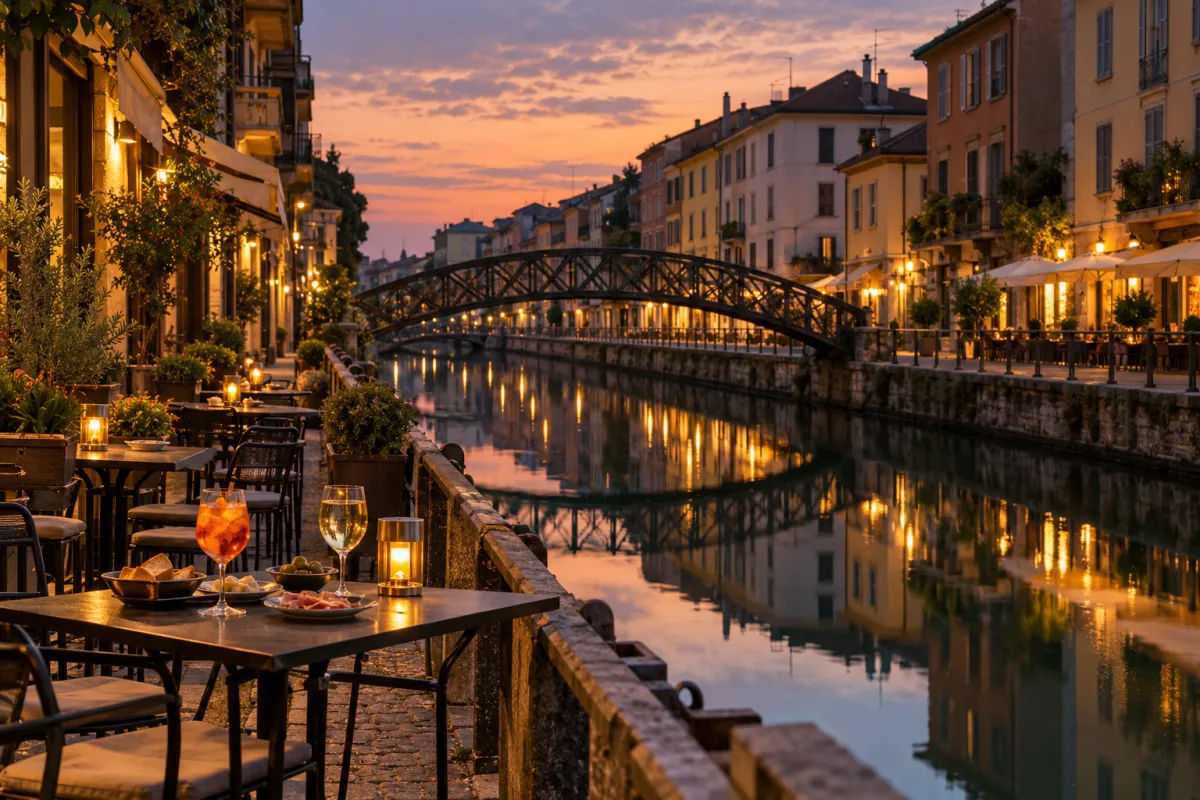
In Milan, aperitivo is practically an institution: an after-work drink with snacks, typically between about 18:00 and 21:00, often in Navigli, Brera, Isola or near the office. It is the easiest invitation you can make. If a colleague or classmate seems friendly, “Shall we get an aperitivo after work on Thursday?” is completely normal and low pressure. Many expats’ first friendships in Milan start at an office aperitivo.
2. Expat networks
InterNations has a Milan community with official events and activity groups such as dinners, hikes and cultural outings. It is useful in your first weeks, when meeting other newcomers quickly helps. Treat the big events as a way to find a smaller, recurring group. Our honest review asks whether InterNations is worth it.
3. Running and parkrun
parkrun Milano Nord is a free, volunteer-run 5 km held every Saturday morning in Parco Nord, one of Milan’s biggest green spaces. The course is two laps of about 2.5 km on mostly tree-lined paths, and walkers are as welcome as runners, so it is an easy first outing even if you have never raced. You register once on the parkrun website and bring your barcode. Volunteering as a marshal or timekeeper is a fast way to meet the regulars, and there is usually a coffee afterwards. Milan also has a lively run-crew scene in Parco Sempione and along the canals; crews usually announce meeting points on social media, so ask at parkrun which ones people like.
4. Professional and women’s networks
Because so many newcomers come for work, professional networks double as social ones. PWN Milan, the Milan chapter of the Professional Women’s Network, runs events and programmes for women in business, with membership options for individuals, entrepreneurs and companies. Business school alumni clubs, chambers of commerce and industry meetups are also active. These are good for building a network, and friendships often follow from the people you see regularly.
5. Language exchanges, courses and tandems
Italian makes life in Milan much easier, especially outside work. University ESN sections have run language-tandem programmes that pair international students with Italians learning their language, and many language schools and universities offer Italian courses with social extras. Outside student circles, look for exchange evenings on Meetup and in bars, and check that they have met recently. A one-to-one tandem is often the most reliable route to an Italian friend; see our guide to finding a tandem partner in person.
6. Volunteering
Volunteering is a meaningful way to meet Milanese people who are not looking for English practice. Food banks, charities supporting homeless people and refugees, and environmental groups all welcome volunteers; Italy’s national food collection days, held each year in late autumn, are a classic one-off way to start. Intermediate Italian opens most doors, but many roles involve practical tasks where language matters less.
7. Design, culture and the city calendar
Milan’s cultural calendar gives you a reason to invite people somewhere. Design Week in spring, when the city fills with installations and events, is the year’s biggest social moment for many residents. Exhibitions, opera at La Scala, football at San Siro and food markets are all easy shared plans.

What a good social week in Milan looks like
| Day | Plan | Why it helps |
|---|---|---|
| Monday | Lunch with a colleague you have not talked to yet | Work is where you spend most hours; start there |
| Wednesday | Italian course or language exchange | Same people every week, plus language practice |
| Thursday | Aperitivo after work with colleagues or classmates | Milan’s easiest social invitation |
| Saturday | parkrun Milano Nord, then coffee | Free, weekly, friendly |
| Sunday | A walk in Parco Sempione or along the Navigli, or a day trip to the lakes | Shared adventures create shared stories |
Two of these, every week, are enough to change how Milan feels within a month. Day trips by train to Lake Como, Bergamo or Turin are also excellent plans to suggest to people you have met a couple of times.
Neighbourhoods newcomers like for social life
- Navigli: canals lined with bars and restaurants, the city’s classic aperitivo district. Lively, sometimes loud.
- Isola: a former working-class area turned trendy, near the Porta Nuova business district, with good bars and a village feel.
- Brera: elegant and artistic, with galleries and cafés in narrow streets. More expensive.
- NoLo and Porta Venezia: multicultural, creative and young, with independent bars and a strong community vibe.
- Città Studi: the university district, popular with students and young researchers.
- Porta Romana: residential and well connected, with a growing food and bar scene.

Local norms: how Milanese people socialise
Practical habits that make Milan social life easier
- Live near your evenings, not just your office. If your social life happens in Navigli or Isola, living within a short metro or tram ride makes it far easier to say yes after work.
- Use the lunch break. Many Milanese offices have a culture of eating lunch together. Joining colleagues for a quick lunch is one of the lowest-effort ways to build workplace friendships.
- Book the weekend early. Because many residents leave town on weekends, plans for Saturday and Sunday are often fixed by Wednesday. Suggest weekend plans early in the week.
- Join something with a season. Courses, sports leagues and choirs that run from autumn to early summer give you the same group for months, which suits Milan’s busy rhythm.
- Say yes to day trips. Milan’s train connections make Lake Como, Bergamo, Turin and the mountains easy days out. Invitations to join one are an excellent sign; accept them.
- Keep a small “newcomer” circle. Fellow newcomers you meet in your first weeks are often the people who stick, because you are all building from scratch at the same time.
Finally, be kind to yourself in the first winter. Short days, grey skies and busy schedules make it tempting to stay in. Keep your two weekly anchors going even when you do not feel like it; they are what carry you through to the spring, when the city’s terraces and parks fill up again and invitations become much easier.
How Milan compares with Rome
Milan is faster, more international and more work-centred than Rome, with social life squeezed around busy schedules and weekends often spent out of town. Rome is slower, more traditional and family-centred, with long lunches and piazza life. If you are deciding between them or moving from one to the other, our guide to the Rome expat community covers the capital’s groups and norms.
Your first 12 weeks in Milan
- Weeks 1–2: go to one InterNations or Meetup event and your first parkrun. Say yes to every office aperitivo. Start an Italian course.
- Weeks 3–4: choose two weekly anchors: one international (an activity group or professional network) and one where Italian is spoken (a sports class, a volunteer team or a language exchange).
- Weeks 5–8: stay for the coffee or drink afterwards, and suggest an aperitivo to someone you have met twice.
- Weeks 9–12: organise something small: a Sunday walk in Parco Sempione, a day trip to Lake Como, a dinner at home.
The same approach works in any city; our guides to making friends in Paris and in Berlin show how it adapts elsewhere.
Copy-paste messages for Milan
- “Great to meet you at parkrun. A few of us are getting coffee after next Saturday’s run, want to join?”
- “Fancy an aperitivo in Isola on Thursday after work?”
- In Italian: “Ti va un aperitivo giovedì sui Navigli?” (Fancy an aperitivo on the Navigli on Thursday?)
- In Italian: “Domenica andiamo al lago di Como in treno, vieni?” (We’re taking the train to Lake Como on Sunday, coming?)
Staying safe when meeting new people
Meet new people in public places, tell a friend where you are going, arrange your own way home and leave if anything feels off. Keep your phone and wallet secure on the metro, trams and in busy areas such as the Duomo and around Centrale station. In an emergency, call 112.
Want to turn this into an actual plan? MeetNow is a free app for meeting people in person: a host posts a plan at a public place, says who pays (host pays, split, pay your own or free) and picks who joins. It is live on the web and works in your browser, starting in Malta. The Android app is on Google Play; the iPhone app is not in the App Store yet. Open MeetNow and see the plans posted in Malta. (MeetNow is our own app.)
FAQ: Milan expat community
How do I make friends in Milan as an expat?
Combine one international network, such as InterNations or a professional group, with one weekly activity, such as parkrun, a sports class, a language course or volunteering. Say yes to office aperitivos and suggest your own after meeting someone a couple of times.
Is the Milan expat community big?
Yes. Milan attracts many international professionals and students, so there are always other newcomers. The community is spread across workplaces, universities and networks rather than a single scene.
Is there a parkrun in Milan?
Yes. parkrun Milano Nord is a free, timed 5 km held every Saturday morning in Parco Nord. Register once on the parkrun website and bring your barcode.
Which Milan neighbourhood is best for meeting people?
Navigli is the classic aperitivo district, Isola and NoLo are young and sociable, Brera is elegant and artistic, and Città Studi suits students and young researchers.
Do I need to speak Italian to make friends in Milan?
Many people in Milan’s international workplaces speak English, so you can start without Italian. But Italian makes everyday life and local friendships much easier, and even basic phrases are appreciated.
Are there women’s networks in Milan?
Yes. PWN Milan, the Milan chapter of the Professional Women’s Network, runs events and programmes for professional women, and there are other women’s and parents’ groups in the city.
Is Milan quiet in August?
Yes. Many residents leave in August, especially around Ferragosto on 15 August, and many groups pause until September.
Groups and schedules last checked October 2026.